Use Cases
This section outlines use cases that highlight the need for the technology described in this paper by discussing the use cases in two categories:
- Verifiable Issuers
- Verifiable Verifiers
A final use case section then checks for commonalities and differences between the two categories
There are a number of other locations that have published use cases that are related to this paper. Rather than include the content of those use cases in this document, they are included by reference:
Verifiable Issuer Use Cases
- Acme Inc. is a producer of medical equipment. Twin Mountains Hospital decided to buy equipment from Acme Inc. The law says that medical equipment should be certified by a 3rd party certification body. Twin Mountains Hospital requests a certification from Acme, Inc.; Acme, Inc. delivers it to them. The hospital then checks if Acme Inc. is in the Verifiable Issuer List of licensed 3rd party certification bodies to see if the Issuer of Acme Inc.'s certification is an approved certification body.
- Note: The solution might need to convey a single item in a List vs. the entire List.
- Note: Many similar certification/license use cases are out there.
- Walmay, Inc. is a wholesaler of drugs. John & Jane is a manufacturer of drugs. Walmay, Inc. finds out that a lot of Adenosine Triphosphate drugs has broken packaging and decides to return the lot to the manufacturer. It is required that all interactions in the drug market happen only between authorized trading partners. John & Jane requests an Authorized Trading Partner (ATP) certificate from Walmay Inc. The certificate credential contains a link to the Issuer. John & Jane then verifies that the Issuer is a member of the Verifiable-Issuer List of Issuers authorized to issue ATP credentials.
- Elena is an IT Administrator in the hiring department of a mid-size company that would like to vet job applicants as having received their degrees from an accredited college or university. Elena configures their hiring software to refer to multiple lists (Verifiable-Issuer Lists) containing several hundred organizations that are curated by the various accreditation bodies that they trust.
- Line is elected treasurer of a Dutch church. In her role as treasurer, she goes online to open a bank account for the church. To comply with certain laws and adhere to internal risk mitigating policies, the bank needs to verify that Line has been authorized by the church to sign on its behalf. For companies, personal information about executive board members is registered by the Chamber of Commerce alongside the registration of the legal entity. However, due to the special sensitive nature of data regarding religious affiliations, the Chamber of Commerce in the case of religious institutions (mosque/synagogue/church) is prohibited from registering any data that can be correlated with a natural person. Instead of checking the Chamber of Commerce public register, the bank requests a credential from Line stating her mandate to sign, which she received from the church. The bank checks whether the church is on the Verifiable Issuer-List of Churches, which is maintained by the Chamber of Commerce. Finding the church on the list, the bank is now able to open a bank account for the church, which Line can administer.

Figure 1: A Verifiable-Issuer List helps verifying whether a diploma is genuine.
Verifiable Verifier Use Cases
See also Verify the Verifier - Anti-coercion by Design; October 2020 | TNO
- Yuri has a digital driver's license and is attempting to rent a car from CarMart. CarMart requests to see Yuri's age, motor vehicle class, and driver's license number. Yuri's software checks against a Verifiable-Verifier List to make sure that CarMart is a Verifiable authority for information of that type, so it can warn Yuri if CarMart isn't trusted to request that information from Yuri.
- Oskar joins a tennis club. The tennis club requests a government-issued proof of birth date. However, the tennis club does not have authorization to ask for this personal information. As a consequence, Oskar’s certified EUDI wallet refuses to present the information, based on the absence of the tennis club in the relevant Verifiable-Verifier List. The tennis club realizes that they cannot obtain this high-LoA information from the EUDI wallet and instead accepts a self-asserted date-of-birth by Oskar.
- Oskar was invited by the European Commission to become an evaluator. Even though Oskar would be paid only the equivalent of a book voucher, the EC requires a full contracting process, which includes an eIDAS LoA high identification and a recent authentic bank statement. Even though Oskar considers these requirements unreasonable, Oskar’s certified EUDI wallet accepts the request, as the EC is registered in the relevant Verifiable-Verifier List. This way, Oskar knows at least that the request is genuine, and that there exists a sufficiently-well-governed policy associated with the request.
- Oskar crosses the border to Dystopia. Immigration requests that Oskar surrender all Verifiable Credentials in his SSI wallet, including identification, driver’s license, diplomas, certifications and other records. Immigration of this country is not authorized to make such a wide request, as it is not included in the relevant Verifiable-Verifier List. As a consequence, Oskar’s certified EUDI wallet refuses to present this information. Even the threat of denial-of-entry or worse cannot change the situation, as neither immigration nor Oskar himself is physically able to compromise Oskar’s EUDI wallet to surrender the information.
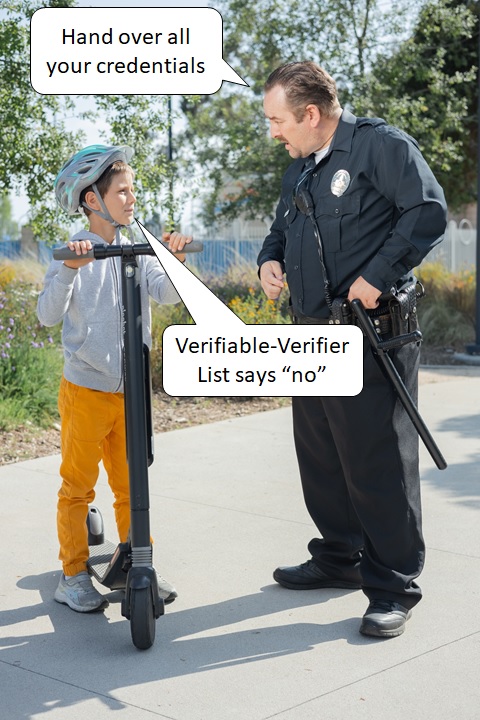
Figure 2: A properly-implemented wallet with Verifiable-Verifier List protects citizens against overzealous law enforcement.
Commonalities and Differences
Conceptually and technically, the two types of lists (Verifiable Issuer, Verifiable Verifier) are fairly similar. Each type is a governed list of parties with a role in SSI exchanges. Each type needs to provide some form of sharing (publication/access), so that the list is available to its users. This paper will presume that the types of lists themselves, as well as their sharing methods, can be technically identical. The only distinction is that a list could contain only Verifiable Issuers, only Verifiable Verifiers, or both, so the data model should accommodate this.
Major differences arise in the applications surrounding the lists. Verifiable Issuer lists target Verifier implementations, whereas Verifiable Verifier lists target Holder (digital wallet) implementations. Also there may be major differences in the governance between the two types of lists, or whether/how the consulting of lists is implemented and enforced. All of these differences are out of the scope of this paper.